Saturday, November 8, 2008

the Doors of Zanzibar

There are a few cities in the world with a concentration of antique wooden doors like Stonetown, Zanzibar. The doors are elaborate carved from hardwood, typically fashioned with nail-less joinery, and decorated with studs and bosses of iron or brass.

A fusion of Swahili, Omani and Indian styles, these portals have become the indelible symbol of Stonetown, now a UNESCO World Heritage site. Distinctively Omani are the flat lintels while the Indians prefer semi-circular ones. Another Indian derivitave are the brass studs which first functioned as spike deterrents against elephants during clan wars in the Indian subcontinent. Symbolim is heavy. Oriental symbols for prosperity are the carvings of lotus and rosettes. Most favored of the decorations though are Islamic in nature, as shown by Arabic inscriptions from the.

When in Stonetown, photographing these antique wooden doors became one of my favorite past-times. I even consider myself lucky having purchased a rare copy of the Doors of Zanzibar, as photographed by Uwe Rawu and written by Mwalim Mwalim. A veritable guidebook for door lovers like me, it lays out a map of some 200 heritage portals in Stonetown.

Here are a few glimpses of these cultural gems:

This door could be of a native Swahili Muslim home. The flat lintels (crossbeam across the top of the door) are Omani architectural preferences. The Arabic inscription above the door can still be deciphered.
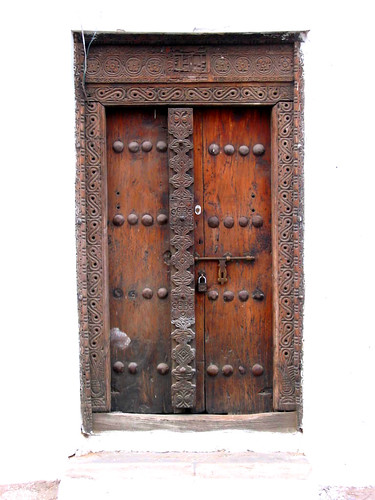
another Stonetown door


Tanzania is lucky to still have forests of hardwood. This door is new as the hotel was built in the 1990s. But the materials they used were impressive- solid thick close-grained rosewood.
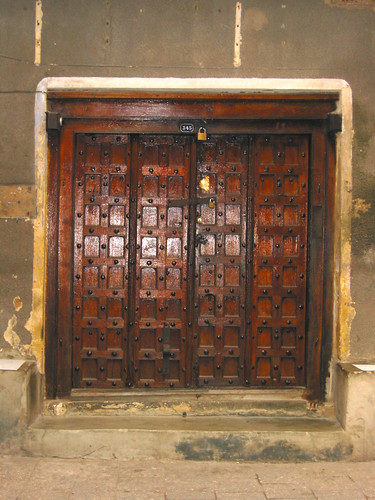
the inn's door


The filigree of the doorpost and lintel is crumbling with age and the door is weather-beaten. But finally I found a door that is open! Feels voyeuristic having a peek inside. The inscription on the building showed the year the house was built.
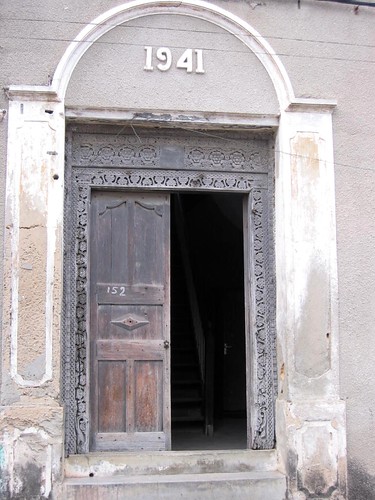
tracery door


This white door, rickety as it is, retains a charm that is wholly Zanzibar. Obviously constructed from heavy hardwood, it has a Koranic carving on the lintel which I most unfortunately cropped (alas!). The locks and studs and the intricate carving evoke the time when slaves used to be traded in this historic East African island port.
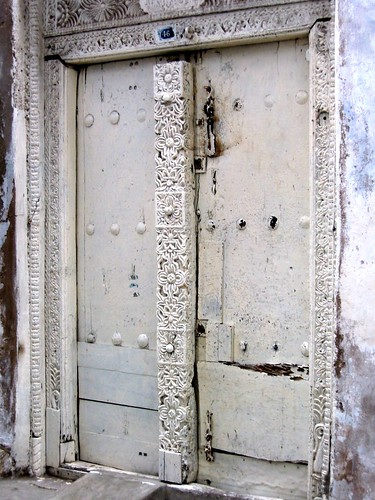
white door


This is another door which has a plaque in Arabic. The repetitive lotus design is Oriental style.
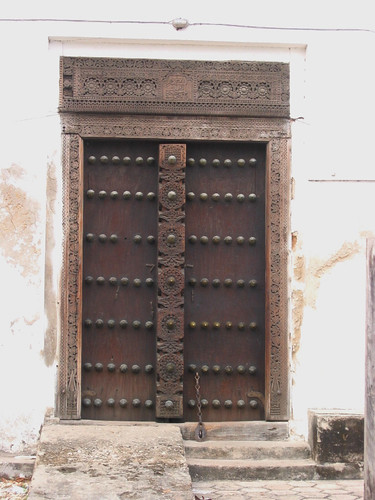
Stonetown door


Below is one of my favorite doors, with an elegant symmetry and delicate filigree carvings.
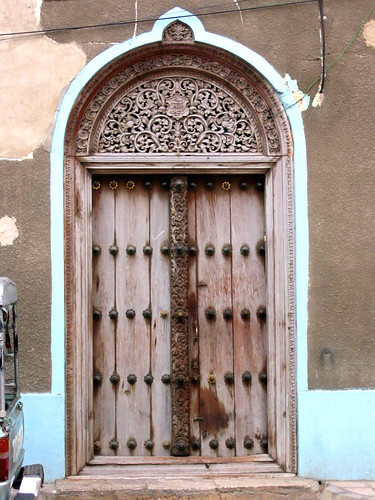
Stonetown door


Restoration funds, like in any third world country, are wanting in Zanzibar so many doors are in need of upkeep. Some of the doors even have missing brass studs. Replacements are expensive. I asked and the large traditional ones are about $10-20 each, depending on design.
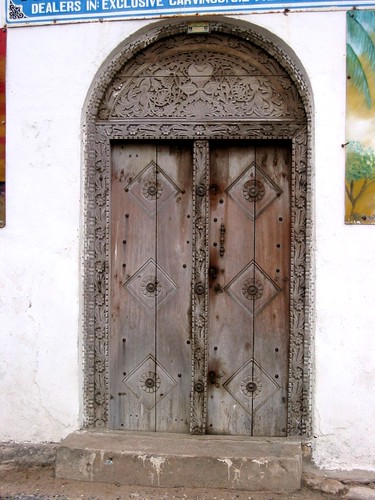
Stonetown door, Zanzibar, Tanzania


One building which has real massive doors is the Beit el-Ajaib or literally the House of Wonders is a truly remarkable building which is now more than 100 years old. It started as a ceremonial palace for Sultan Barghash which boasted of the first electric light and elevator in the island. Now a National Museum, it is one of the largest buildings in Zanzibar.

Its main door bears a rather English-looking coat of arms, which probably was the seal of the sultan of Oman.
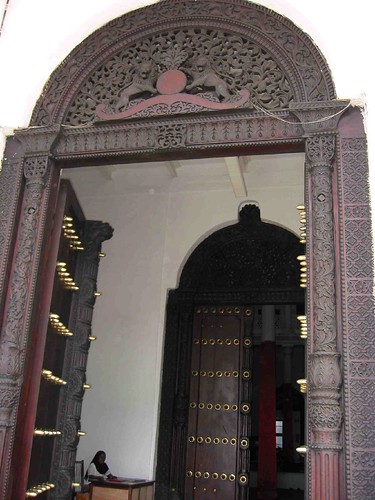
doorway to the Beit el-Ajaib

Stumble Upon Toolbar

the Nusa Dua Fiesta 2008, part 1

At the onset of my latest trip in Bali, I was pessimistic that would not have any time to have some “cultural” downtime. My schedule in Bali looked impossible. After arriving on a Friday, I needed to leave on Saturday for Bima, stay there overnight and then fly back to Bali on Sunday. On Monday, I would go to Lembongan Island and on Tuesday morning would be my departure.

Delightfully surprised was I when upon checking in at the hotel, I found a flyer for the Nusa Dua Fiesta 2008. I’ve heard a lot about the Nusa Dua Festival, a recent annual celebration by the premier 350 hectare tourist enclave south of the island. It is a small scale version of the Bali Arts Festival and is organized by the foundation, the Bali Tourism Development Corporation. This year however, the festival site has been moved to what would seem to be its new permanent location, the peninsula island, which I always frequented for its sunrise-facing “water blow” promontory and its small charming temple, the Pura Bias Tugel. (Actually, this is not an island but a projecting peninsular cape that has a plaza with a nice jogging track.)

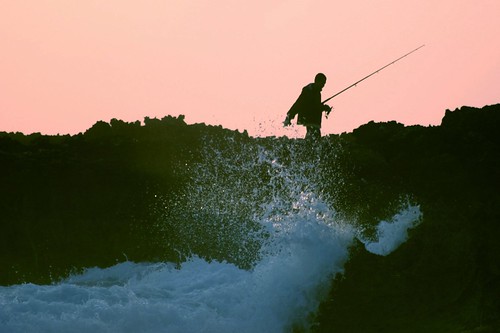
mancing
a fisherman working early during sunrise at the peninsula island in Nusa Dua (September 16, 2006)
Canon EOS 350D Digital, 1/400s, f/5.6, 300mm, ISO 100, -1/3EV


saunter
a silhouette of my wife near the Pura Bias Tugel, also during sunrise (October 23, 2006)
Canon EOS 350D Digital, 1/125s, f/5.6, 46mm, ISO 200, -2/3EV


The program for the festival which ran from October 10-14, 2008 looked promising, with performances, competition and workshops for arts including dance and music, sports activities and the usual pameran-style exhibition booths . I was attracted to the lineup on the only evening I would be available, Sunday October 12.

So there I went, with a couple of Balinese friends in tow.

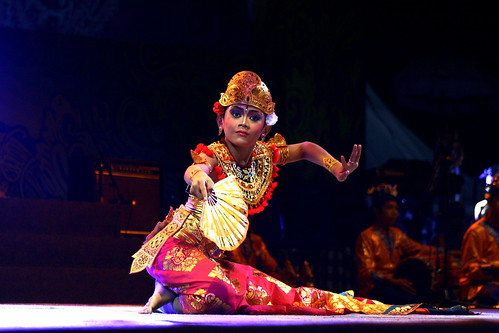
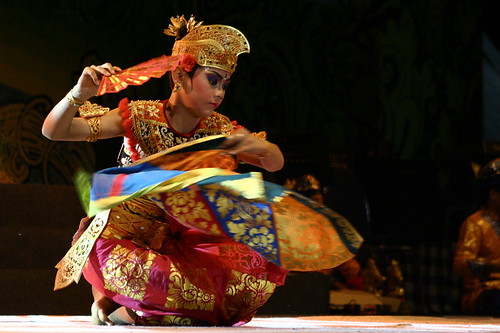
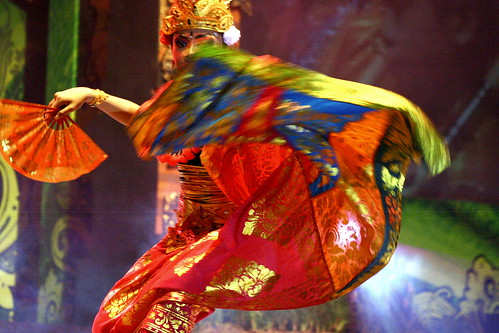
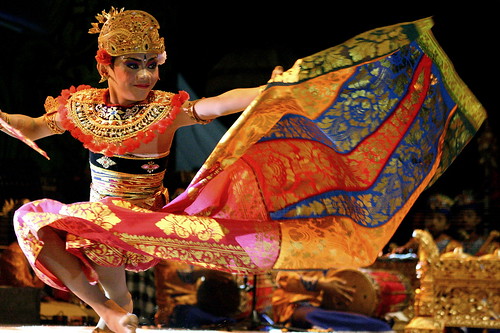
Of all four dances which I caught on camera, I was most fascinated by a solo dance called the Tari Kebyar Duduk, a relatively modern choreography done almost solely in a sitting position (duduk is “to sit” in Indonesian). The young dancer, a member of a featured “master class” guild wore a traditional Balinese costume of
anteng
, a long strip of stiff gilded prada/perada cloth bound around their torso like a tube and a kamben sarung skirts that has a long mermaid’s tail that is flipped gracefully all throughout the dance.

Tari Gebyar Duduk (3)
Canon EOS 350D Digital, 1/250s, f/4.5, 155mm, ISO 800, -2/3EV


Tari Gebyar Duduk (3)
Canon EOS 350D Digital, 1/200s, f/4.5, 185mm, ISO 1600, -2/3EV


the twirl
Canon EOS 350D Digital, 1/160s, f/4.0, 80mm, ISO 1600, -1.0EV


Tari Gebyar Duduk
Canon EOS 350D Digital, 1/250s, f/4.5, 105mm, ISO 1600, -2/3EV

Next: more of the dance performances

Stumble Upon Toolbar

Thursday, November 6, 2008

Elegance in stone: the Camposanto of San Joaquin

At the south-end of the province of Iloilo is an unassuming town called San Joaquin. Some 53 kilometers away from Iloilo City, the historical town is one of the oldest in Panay island, having been cited as the site where the 10 Borneon datus settled in the 12th century.

The town also boasts of two Spanish era architectural gems, its church and lo and behold, its cemetery. In my trip to Iloilo this summer, I only had a day to spare and I was able to squeeze visits to 9 old churches and the one cemetery that is not to be missed, that of San Joaquin.

camposanto de San Joaquin
Canon EOS 350D Digital, 1/160s, f/5.6, 21mm, ISO 100, +1/3EV


The San Joaquin Catholic Cemetery was built in 1892. Its old iron grill gate opens to a small flat plaza of coralline cobblestone and grass gardens at its side. A 20-step stone staircase leads directly to its most famous feature, the camposanto or the funerary chapel.

San Joaquin camposanto staircase
Canon EOS 350D Digital, 1/125s, f/5.6, 18mm, ISO 100, +1/3EV


The capilla is hexagonal and is built of calcareous coral stone quarried from nearby limestone coast and red bricks of clay. It is capped by a copula roof with an iron cross at its apex.

San Joaquin Camposanto (2)
Canon EOS 350D Digital, 1/160s, f/5.6, 33mm, ISO 100, +1/3EV


Florid carvings of flowers and leaves decorate the exterior walls of the chapel, particularly surrounding the door and the roseate windows. There are also carved skull and crossbones, as well as cherubs. At the corners of the hexagon are urn-like finials.

San Joaquin Camposanto
Canon EOS 350D Digital, 1/200s, f/5.6, 25mm, ISO 100


Characterized as oriental baroque, the architecture is elaborate in ornamentation, solid in built and delicate and surprising light in appearance, as if it floats on the hill.

San Joaquin Camposanto window
Canon EOS 350D Digital, 1/160s, f/5.6, 48mm, ISO 100


Too bad that the chapel door was bound and locked. Identified and cherished as a historical monument, the camposanto is by no means cold and desolate. It is still in active use and remains a living testament of the faith of the people of San Joaquin in the life beyond the living.

San Joaquin is about an hour and a half from Iloilo City by jeepney.
My deepest thanks too to Bernie for being our knowledgeable tour guide during our Iloilo visit.

Stumble Upon Toolbar

Wednesday, November 5, 2008

to the ends of the earth (er, Africa), part 2

continued from to the ends of the earth (er, Africa), part 1

When the street sign finally read Cape Point Road, everybody became more animated. We definitely were approaching our final destination already.

But first, we were treated with the beautiful meadows of Cape of Good Hope Reserve of the Cape Peninsula Park. Windswept, rugged, with scarcely any thickets of trees, the reserve is an extraordinary terrain of rich and diverse fauna and unique flora. An integral part of the Cape Floral Region Protected Region, the reserve is recognized and protected as a UNESCO World Heritage site for the outstanding diversity, density and endemism of the flora, rated as among the highest in the world.

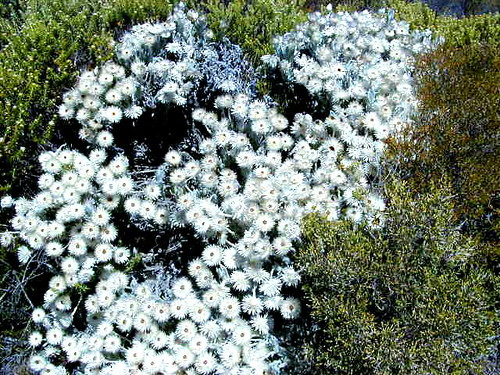
Collectively characterized as Fynbos vegetation, the flora include proteas (South Africa’s national flower), restios (Cape reeds), ericas (heaths), daisies, irises, lilies, pelargoniums (geraniums) and freesias. The tour guide cum driver bragged that the reserve is more heathland than Scotland, known as the “land of heather”, for the park has about 600 species of flowering heather (Ericaceae). I guess she is right. Scotland, after all, only has 4 and the rest of the world has 26.

silver heather
silver heather along the Circular Road near Cape of Good Hope, South Africa


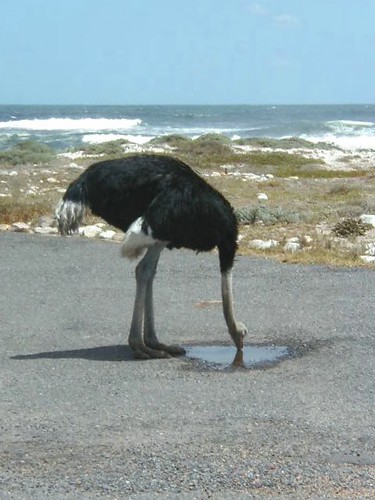
As we pushed towards the Cape of Good Hope, our car made several more stops. Endemic wildlife were roaming around the reserve. We chanced upon wild ostriches. We were told though to be careful with them as they are known to occasionally chase and peck the unsuspecting tourist. When one particularly large ostrich elegantly stooped to drink water from a puddle by the road, I quickly took a snapshot.


Thirsty
cool relief in a parching hot day on the road, Cape of Good Hope, South Africa


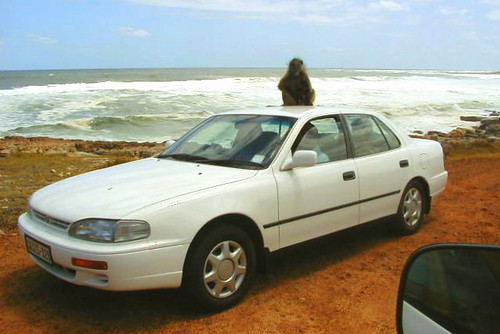
What really are considered more dangerous are the troops of territorial cape baboons. These chacma baboons (Papio ursinus) live in social groups, often numbering near 50. Together, these animals can be aggressively dangerous especially those whose behavior have been modified by frequent feeding by tourists. Well meaning generosity could easily make baboons more dependent on man whom they may see as a source of food. The basic protocol is, when approaced by baboons, seek the protection of your car and roll up the windows. Today it is illegal to feed baboons to ensure that they stay self-reliant in the wild. Sadly, baboons that have been conditioned to receive food from humans may have to be destroyed.


baboon!
unnerved by the territoriality of one of the baboons, tourists locked themselves inside their car by the road, near Cape of Good Hope


Finally, we came to the end of our journey. Cape of Good Hope, like any cape, is a strip of land projecting into a body of water. But this is no ordinary cape.

There are two false myths associated with the cape.

One, the Cape of Good Hope is the meeting place of the Atlantic and Indian Oceans. This is not true. The real juncture is Cape Agulhas. However, the Cape of Good Hope does witness the meeting of two of earth’s most contrasting water masses- the cold Benguela current (west) and the warm Agulhas current (east).

beach trail
at Capepoint, South Africa
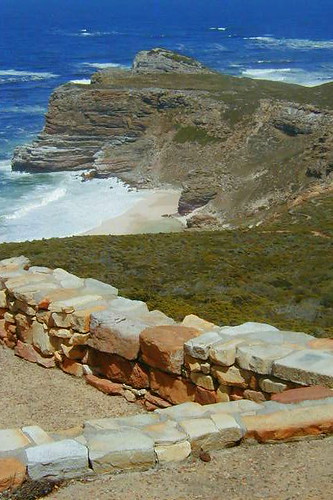
a beach trail at Capepoint


The second misconception is the Cape of Good Hope is the southernmost tip of Africa, hence the misnomer end of the earth. In the Middle Ages, this may impression might have stuck, as explorers coming from the Atlantic Ocean probably saw the protruding cape as the edge of Africa. In reality, the tip, again, is Cape Agulhas.

Notwithstanding the reality checks, the Cape of Good Hope and Capepoint – the two are the west and east end of the Cape Peninsula –are breathtaking. As Sir Francis Drake aptly put in 1580, it is “the most stately thing and the fairest cape we saw in the whole circumference of the earth”.

Among the points of interest at the well-developed cape peninsula are two navigational beacons named after the two Portuguese explorers whose expeditions opened the Cape sea route to the East, Bartholomew Dias and Vasco da Gama. Other attractions include tidal pools, whale watching, shipwrecks, a funicular named after the Flying Dutchman, a restaurant and the ever present visitor center and shop.

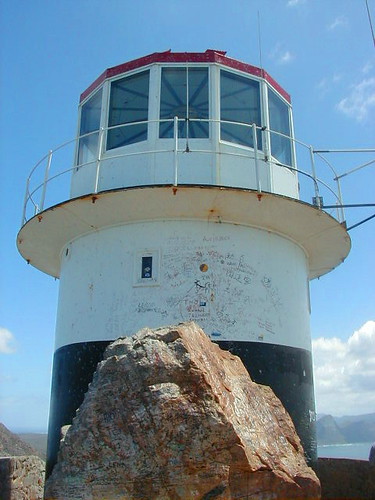
Capepoint Peak lighthouse, South Africa


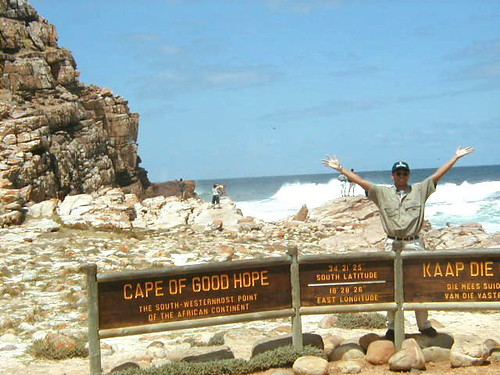
Winding up the tour, I could not help but do what I almost never do, pose. I am used to traveling alone so by habit, I took up photography not to immortalize my mugshot in personal postcards but to capture the beauty of the scenes that I have been lucky to see, and share them to family and friends. This time though, I gave in and asked a fellow tourist to take a picture of me at the good old Cape of Good Hope.

Why not, when I am already at the end of the earth? (Not really, but that is close enough for me.)

celebrating at the southernmost tip of Africa (the mainland, at least)


For Cape tours, check out classiccape.co.za. Today, the tour charge is R525/person exclusive of cablecar ticket vs R285 in 2001. Tours depart from Capetown 09:00 and return 17:00.

Stumble Upon Toolbar

Tuesday, November 4, 2008

to the ends of the earth (er, Africa), part 1

My first travel to the continent of Africa was way back in 2001. Destination: Capetown, South Africa. Seven years have passed – this was three digital cameras ago – I can still remember them vividly.

To say that I was excited was an understatement. I attended a week-long conference which fortunately afforded me about 2 days of free time. For sight-seeing, my choices were made even before the trip.

On top of my list was to go to Cape of Good Hope. Many a times in school did I encounter this tip of Africa, whose discovery was vital to the opening of a route to the Far East during the Age of Exploration. To be there, to stand on the “edge of the earth” where the Flying Dutchman used to reign (again, this was in 2001, before the Pirates of the Caribbean lorded over the box office) would be a dream come true.

True enough, the Cape Peninsula/Cape Point day tour I chose did not leave me wanting.

Leaving Capetown at around 9AM, the south road route was spectacular. The 70 kilometer ride took me around the rugged natural coast.

First in the itinerary was the majesty of Chapman's Peak Drive, with its spectacular view of roiling seas and white beaches.

the Fisherman's wharf
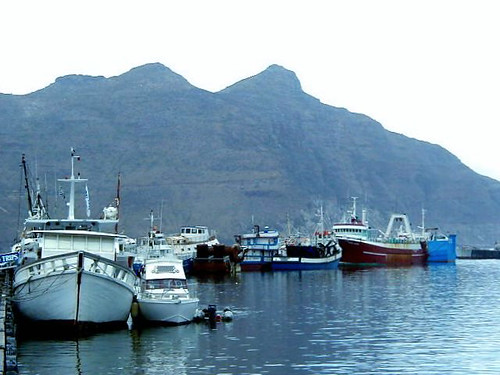
boats leaving for Seal Island at the Mariner’s wharf


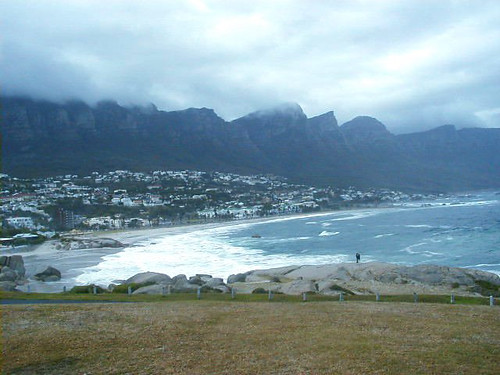
Then the drive took a turn to a series of beautiful white beaches along the western arc of False Bay. We stopped at several points. One particular promontory in Camp’s Bay gave us a jaw-dropping view of the famous Twelve Apostles peak.

The 12 Apostles
the Twelve Apostles peaks, as seen from Camp’s Bay

As we went further south, I could not help notice that along the hilly banks are houses of the rich and fabulous. The year 2001 was a little more than 5 years after the lifting of apartheid so despite the affluent projection of the city – there definitely was that Mediterranean feel all throughout the route – you could still sense a palpable economic divide among the white Afrikaners and the black majority.

Crime rate must be high. The villas definitely were fully guarded, with high walls and electrical fences. Signs of “Armed Response” were all over the place, which meant that a private protection agency provides immediate assistance to the household within minutes of intrusion. Vehicles are likewise under a similar 24 hour protection from hi-jacking. In fact, to facilitate helicopter assistance, cars also are painted numbers on their roofs for quick tracking. Coming from a developing country like the Philippines where crime is also an issue, I shook this off nonchalantly.


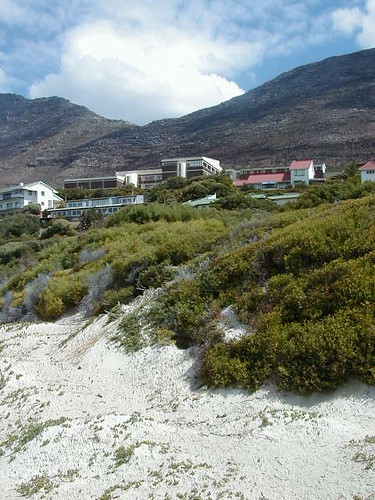
houses at Boulder's Beach
houses along Boulder Beach are typical of the affluent residences along False Beach

The coastline of False Bay boasts of seemingly endless white beaches, with names like Muizenberg, St. James and Kalk Bay. The water temperatures were not to my liking though. It was February, the height of summer, but the surface temperatures were in the low 20s centigrade. That cold I could not stand so never was I tempted to dive in.

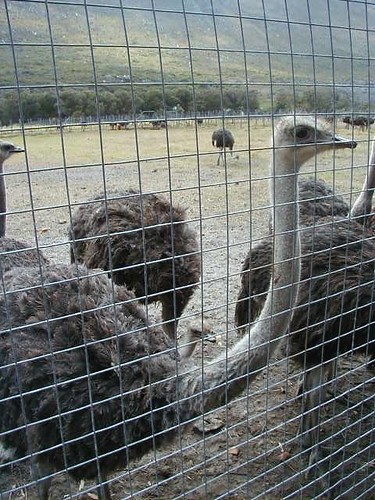
Africa is in your face all throughout the drive. There were stops to show us an ostrich farm, heather meadows and troops of baboon.


Ostrich Farm
an ostrich farm at the Cape of Good Hope Nature Reserve


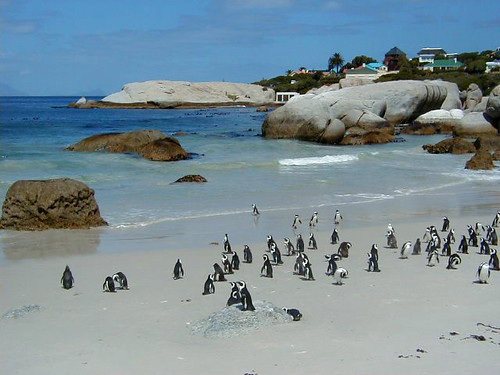
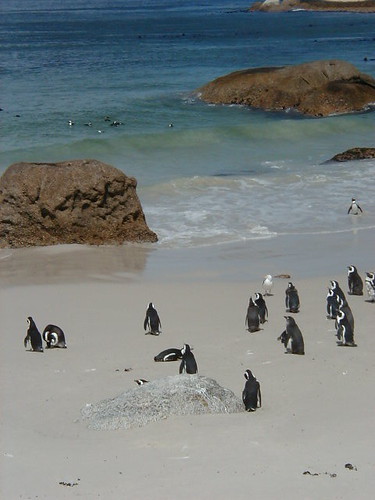
What impressed me most, as far as animal showcases were concerned was the detour at the Boulders Beach Coastal Park in Simon’s Town for the world renowned colony of African (Jackass) penguins (Sphensicus demersus, so named for the donkey-like cry they make when on land.

Boulder's Beach
a waddling colony of penguins at Boulder’s Beach, Simon’s Town, South Africa


This was my first time to see real penguins in their habitat and what a habitat they chose! Of all 16 species of penguins spread in only 28 sites in the world, it is these penguins which uniquely inhabit a public beach where people also frequent. While these birds are almost totally adept at sea, spending long periods in the waters to feed on pichard, fish and squid, they are clumsy on land.

Penguin Colony
more penguins at Boulders Beach, False Bay, South Africa


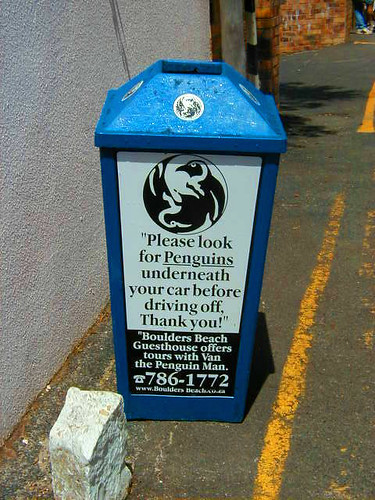
True enough up to the 1970s, these penguins were vulnerable to human exploitation and predators. In the last 30 years though, they are now protected by the Southern African National Foundation for the Conservation of Coastal Birds (check out sanccob.co.za) which is considered to be among the most successful sea bird rehabilitation centers in the world. Protection of their breeding grounds in the beach is stipulated by law. In fact, signages all throughout Boulder’s Beach indicated how far-reaching the safeguards, even to the point of humor.

sign at Penguin Colony at Boulders Beach, False Bay, Capetown, South Africa
a sign at Boulders Beach which made me smile

Next, the conclusion: Cape of Good Hope and Capepoint

For Cape tours, check out classiccape.co.za. Today, the tour charge is R525/person exclusive of cablecar ticket vs R285 in 2001. Tours depart from Capetown 09:00 and return 17:00.

Stumble Upon Toolbar

Monday, November 3, 2008

a taste of Vanille

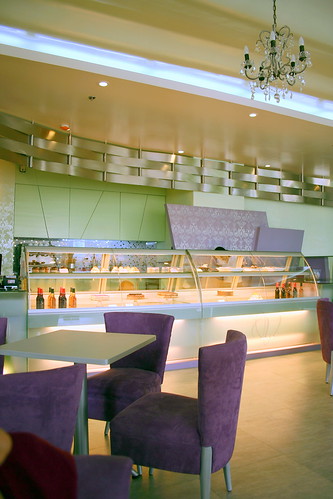
We first saw Vanille Cafe and Patisserie last October 31, when we were browsing through Cebu Ayala Mall’s The Terraces, the newest swanky dining-place to be which opened the day earlier. Dessert hound that I am, I made a must-visit mental note. The ambience is certainly promising. It offers a cozy statement of class- creme walls with stenciled Victorian patterns, tiled mosaic splash, plump purple velvet-upholstered chairs and three crystal chandeliers. Most of all, the cakes, from the outside, scream of a delectable promise. Alas, we just enjoyed a full lunch and sweets can be had some other time.

Vanille
Canon EOS 350D Digital, 1/50s, f/3.5, 18mm, ISO 100


So two days later, we made it a point to hit the cafe before we partook lunch. A bit of a reversal to have dessert first but as people know, pastries are my priorities. My wife and Cacing were willing to oblige.

The young twenty-something pastry chef Valerie Lua is totally unassuming. We were the first sit-down customers that morning so she attended to us personally. Surprisingly shy, she stuttered repeatedly when we peppered her with questions. Vanille is obviously her baby. Together with her sister Vanessa, she opened the cafe to pursue the dream of setting a pastry shop they can call their own. Her inhibition belie her solid qualifications: she graduated from no less the Le Cordon Bleu in Paris, arguably the premier culinary arts school in the world (it certainly is the largest, being present in 20 countries). A news article also pointed to her training in the famous Jules Verne restaurant in the Eiffel Tower. (It recently made news when Tom Cruise proposed to his present wife Katie Holmes).

What exactly does the shop offer? French-Filipino fusion. Imagine the exacting codified demands of French fare but with the introduction of decidedly Filipino ingredients. How is the response of the Cebuanos to her baked delights? “Overwhelming, “ Valerie avers. She cannot keep up with the orders and her backlog is keeping her from experimenting with new flavors and designs.

On offering that day were four pastries. We tried out three.

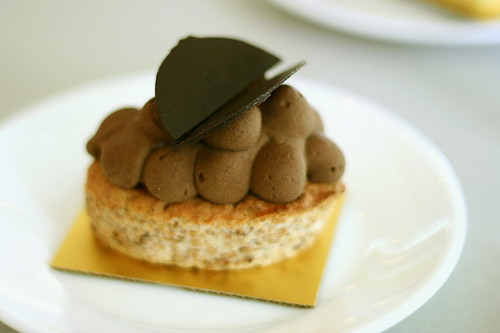
1. Isabelia. This concoction has for its base a special peanut dacquoise which is a cake of nut meringue and buttercream. The upper half are dollops of chocolatey mousse. The twist is that local tableya (cacao bean paste used for cocoa sikwate drink) is used as the chocolate ingredient. Half moon slivers of this bitter tableya chocolate garnished the ensemble with panache. Having both alkaloidal bitterness and sugary sweetness dance together in my tongue is divine!
price= P80

isabelia
Canon EOS 350D Digital, 1/80s, f/1.8, 50mm, ISO 200, -1/3EV


2. Ube. This is an opera cake to crave for. A true French classic, opera cake typically features layers of sponge cake, almond biscuit, white chocolate ganache, coffee buttercream and chocolate glaze. In Vanille, chocolate and coffee were replaced with ube, that distinctively purple yam cherished in Filipino desserts, whipped into a mousse. Being a fan of anything ube, from halaya paste to ice cream to hopia, I can only fawn and wish that my serving was larger.

calypso
Canon EOS 350D Digital, 1/250s, f/1.8, 50mm, ISO 200


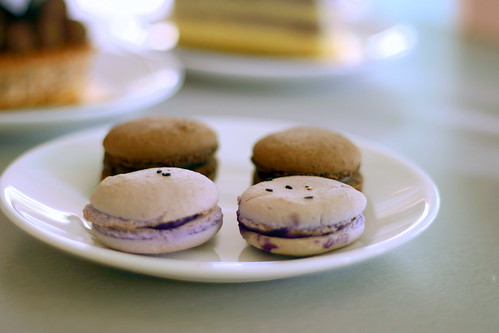
3. French macaron. Finally, French macarons, the real Mccoy, have arrived in Cebu! Not to be confused with the dense English-style coconut macaroons that Filipinos are familiar with, this traditional French pastry is a sandwich of round meringue flats with creamy ganache between the layers. As in any meringue delights made primarily of egg white and sugar, the crisp smooth cookies literally melt in your mouth leaving the decadent and rich cream to deliver the coup de grace. Again, Vanille chose cocoa tableya and ube as flavors and I cannot be any happier.
price= P25 each

French macarons
Canon EOS 350D Digital, 1/100s, f/1.8, 50mm, ISO 100, +1/3EV


As I savored the last pieces of cake in my mouth, I was left to wonder what other heavenly delights Vanille has to offer. Vanessa assures us that she’ll introduce new concoctions in the following weeks, weekly if she could. Our expectations would be high but somehow we know that the first rate cafe that is Vanille will deliver.

Vanille Cafe and Patisserie
The Terraces, 2nd level
Cebu Ayala Mall
Cebu City, the Philippines


More on Vanille in part 2 and part 3.

Stumble Upon Toolbar